


FDA Research Signals a Turning Point for Human-Relevant Cardiac Safety Testing

New FDA publications strengthen the case for replacing animal studies with human-relevant cardiac safety assays where scientifically appropriate
For more than a decade, regulators, pharmaceutical companies, and technology developers have worked toward this goal. Two recent publications from researchers at the U.S. Food and Drug Administration (FDA) suggest cardiovascular safety testing may now be approaching an important inflection point.
In one publication, FDA researchers led by Lead Toxicologist Natalie Simpson, Ph.D., showed that human induced pluripotent stem cell-derived cardiomyocytes (hiPSC-CMs) predicted clinical cardiovascular repolarization risk with accuracy comparable to traditional nonclinical animal studies. Across more than 20 Investigational New Drug (IND) applications, hiPSC-CM assays showed strong agreement with clinical QT outcomes and performance that matched or exceeded conventional approaches. Adding further animal studies provided minimal predictive benefit, supporting broader application of the 3Rs principles—Replacement, Reduction, and Refinement—where scientifically appropriate.
A related FDA review published one year earlier examined more than a decade of hiPSC-CM submissions and documented their growing use in drug development programs. The review also highlighted the agency’s increasing interest in how these studies can inform regulatory decision-making.
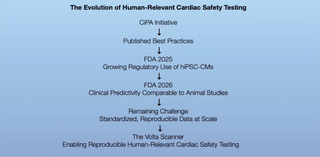
Together, these publications mark an evolution in cardiac safety assessment. The question is no longer whether hiPSC-derived cardiomyocytes have value, but how to generate rigorous, reproducible, and standardized datasets that can support broader regulatory acceptance.
The FDA’s evolving perspective on cardiac new approach methodologies
The FDA’s 2025 review documented a clear rise in hiPSC-CM studies submitted from 2020 to 2023. Most used multielectrode array (MEA) or optical voltage-sensing (VSO) platforms, reflecting growing confidence in these technologies for assessing cardiac electrophysiology.
FDA reviewers noted that hiPSC-CM studies were often submitted alongside traditional hERG assays and in vivo QT studies, with about half discussed during regulatory review. Reviewers did not characterize these assays as deficient or uninterpretable. Instead, the authors cited examples where hiPSC-CM data helped address questions about proarrhythmic risk, contractility, ion channel pharmacology, and drug-drug interactions.
The review also raised a central question: could future regulatory decisions rely more heavily on human-cell-based assays in cases where additional animal studies are now performed? The FDA’s 2026 analysis brings that possibility closer to reality.
Clinical predictivity comparable to traditional animal studies
The 2026 publication asked a direct question: how well do hiPSC-CM assays predict clinical cardiovascular outcomes?
Across more than 20 IND applications, hiPSC-CM assays showed clinical QT predictivity comparable to traditional nonclinical animal studies and stronger than hERG assays alone. Adding animal studies produced negligible improvement, suggesting that animal testing could be reduced in some cardiovascular safety assessments without compromising scientific confidence.
These findings mark a significant milestone for cardiac new approach methodologies. The evidence for hiPSC-derived cardiomyocytes is growing; the remaining challenge is implementation.
The remaining bottleneck: reproducibility at scale
While the FDA publications support the promise of hiPSC-derived cardiomyocytes, they also point to practical barriers that still limit broader regulatory adoption.
The 2025 review found that many submissions lacked detailed methods, standardized reporting, complete cell-source information, raw datasets, defined acceptance criteria, and sufficient discussion of clinical relevance. Greater consistency and study rigor will be essential for increasing regulatory confidence.
Encouragingly, the field has made substantial progress toward standardization. Collaborative efforts such as the Comprehensive in vitro Proarrhythmia Assay (CiPA) initiative, HESI-sponsored validation studies, and ICH E14/S7B Questions & Answers guidance have produced protocols and best practices for hiPSC-CM assays. These resources give investigators a common framework for improving reproducibility, comparing results across laboratories, and accelerating adoption of human-relevant cardiac safety models.
The challenge is no longer defining best practices, but executing them consistently across operators, laboratories, and drug development programs.
The FDA also noted that relatively few IND submissions include hiPSC-CM studies, limiting the evidence available to characterize assay predictivity across therapeutic areas. Expanding regulatory confidence will require larger, high-quality datasets generated with standardized methods. The remaining bottleneck is increasingly operational rather than scientific.
Reproducibility begins with the measurement platform
The FDA publications repeatedly identify study quality, standardization, and reproducibility as prerequisites for broader regulatory acceptance of hiPSC-CM assays. Published protocols define best practices, but the measurement platform is equally important to producing reliable data.
Reproducibility depends not only on the biological model, but also on the instrumentation used to measure it. Stable optical systems and standardized acquisition parameters help ensure that variability reflects biology rather than the measurement process.
This is where the VOLTA Scanner provides a clear advantage.
As laboratories expand hiPSC-CM use in cardiovascular safety assessment, study complexity grows quickly. Multiple compounds, concentration-response curves, biological replicates, cell lots, and controls can produce thousands of measurements, making consistency harder to maintain.
The VOLTA Scanner helps laboratories run standardized, high-throughput hiPSC-CM assays with the consistency needed for confident decision-making.
By combining standardized optical acquisition with reproducible workflows, the VOLTA Scanner reduces operator-dependent variability and improves consistency across studies. Uniform acquisition parameters across wells, plates, and experiments help researchers generate datasets that are more reproducible within laboratories and more comparable across programs. Rather than simply increasing throughput, the VOLTA Scanner enables larger compound sets, broader concentration ranges, and more biological replicates while maintaining standardized execution. The result is stronger data for internal decision-making and future regulatory submissions.
As regulators continue evaluating new approach methodologies for cardiovascular safety assessment, the ability to generate high-quality, reproducible human-cell data will become an increasingly important advantage.
Building the evidence for the future of cardiac safety testing
The FDA’s recent publications deliver a clear message: human-derived cardiomyocyte models are now powerful tools for cardiovascular safety assessment.
The scientific foundation is in place. Standardized protocols now guide assay design and execution. The next challenge is generating large, reproducible datasets that can accelerate regulatory acceptance and reduce reliance on animal studies where scientifically appropriate.
Meeting that challenge requires more than adopting hiPSC-derived cardiomyocytes. It requires standardized workflows, appropriate concentration ranges, sufficient biological replicates, and reproducible data across studies and laboratories—the same elements FDA reviewers have identified as essential for confidence in cardiac new approach methodologies.
The VOLTA Scanner helps laboratories turn published best practices into standardized, high-throughput workflows. By reducing operator-dependent variability and supporting larger compound sets, broader concentration ranges, and more biological replicates, it helps generate the consistency required for confident decision-making.
By combining standardized optical measurements with reproducible workflows, the VOLTA Scanner enables high-quality datasets that support regulatory submissions, strengthen internal decisions, and advance human-relevant cardiac safety testing.
The FDA has shown that hiPSC-derived cardiomyocytes can provide clinically meaningful cardiovascular safety insight. The next phase will be defined not by proving these models work, but by generating the reproducible evidence needed to make them routine.
The VOLTA Scanner helps make that future possible.
- Jul 08, 2026
- Simpson, N. E., Feaster, T. K., Blinova, K., & Sadrieh, N. (2026). In vitro cardiac new approach methodologies predict clinical cardiovascular repolarization risk comparable to non-clinical animal studies. British Journal of Pharmacology, 1–15.(opens in new window)
- Simpson, N.E., Bourcier, T., Sadrieh, N., A Food and Drug Administration/Center for Drug Evaluation and Research nonclinical perspective on the use of human-induced pluripotent stem cell-derived cardiomyocyte data for cardiovascular safety assessment (opens in new window)